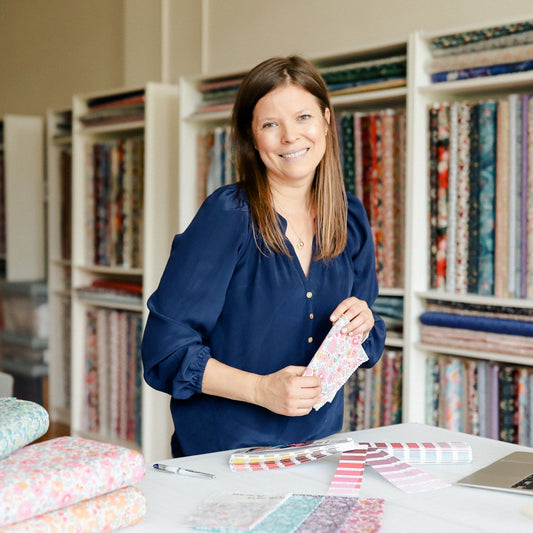
We return with a new Maker Feature! Today we have the pleasure of chatting with Larissa Oliveri, a talented garment maker and storyteller. Larissa runs a YouTube channel, A Mindful Clothier where she shares a beautiful blend of storytelling and sewing technique. We admire her intentional approach to garment making and her openness to sharing the full process with her viewers. We met Larissa while she was making the gorgeous Wild Flowers (H) that she shared in her most recent YouTube video. You can watch the full video: Sewing a Couture Summer Dress in Liberty Tana Lawn | Wild Flowers of My Childhood on her YouTube channel - we're sure you will learn something new!
We had a fantastic chat with her about this dress, implementing couture sewing techniques, and her history with sewing. We are pleased to share this conversation with you!
Without further ado, Larissa!

DuckaDilly: Which came first for this dress - the print or the pattern?
The fabric came first. It was a gift from my husband, who knows exactly what I like, and when he brought it back from London, I immediately fell in love with the Wild Flowers print.
The moment I saw it, I felt as though I had traveled back into my childhood — to those long, carefree summer afternoons spent with my great-grandmother Maria, walking through the fields, collecting medicinal herbs, flowers, and berries. Somehow, every flower I remembered from those days seemed to be there in the print. I found it mesmerizing.
I became curious about its history and wanted to know who had created it and what inspired it. That curiosity led me to the artist Su Blackwell, whose artwork was commissioned by Liberty London and became the inspiration for the Wild Flowers print.
So, in a way, the fabric chose the dress. Once I had the fabric, I knew I wanted to create something that would allow the print to take center stage.
Below is an image of Su Blackwell's original art, Wild Flowers of the British Isles, that inspired the Wild Flowers print.
Blackwell's delicate paper sculpture made from a vintage book captures a field of wildflowers with tiny butterflies flitting through. It is remarkable to see how masterfully this intricate paper sculpture was translated to Tana Lawn®.

Image courtesy of Su Blackwell. www.sublackwell.co.uk. instagram @sublackwellstudio

Fabric: Wild Flowers (H)
Pattern: Burda 5820
DD: You used the Burda Style 05/2023 Dress Pattern 106 (also available as the standalone paper pattern Burda 5820). What modification(s) did you make to this pattern?
Larissa: I grew up watching my mom sew with Burda patterns, so using one for this dress felt a little nostalgic. I loved the pattern's simple, elegant, ladylike silhouette, which I thought was perfect for this lightweight fabric. This pattern is available as a PDF on BurdaStyle.com or as the paper pattern Burda 5820.
My main adjustment was to the upper back. I usually have some excess fabric across my back in most patterns — I have an S-shaped posture like many of us and need to do more fitting there. This pattern was a little more challenging because it has back waist darts but no shoulder darts; instead, the upper back is shaped with extra fullness to accommodate the shoulder blades. That created too much fabric on me, so I removed the excess and reshaped the center-back seam to be straighter through the upper back and slightly curved inward below.
I also added about three inches to the skirt length, as I am tall. Normally I need to lengthen the bodice as well, but this pattern fit my torso perfectly, so I left it unchanged. Finally, I avoided a center-back seam in the skirt, which allowed the directional floral print to flow uninterrupted — I simply cut both the front and the back on the fold to eliminate that extra seam. This is entirely optional.
The bodice with the yoke is long enough for me to insert the full-length zipper and still comfortably put the dress on, without needing an additional seam in the back of the skirt.

DD: In your YouTube video, you mention that this was an exploration of couture techniques on cotton fabric. Can you tell us about how working with cotton changed the experience for you?
Larissa: I run a YouTube channel called A Mindful Clothier, and my intention is to inspire home sewists to try better finishes and more thoughtful sewing techniques. I think that when we hear the word “couture,” we can sometimes feel intimidated and think it is not accessible to us — that couture garments can only be made from exclusive luxury fabrics in high-end ateliers by master couturiers.
For me, couture sewing is really about attention to detail: careful seam finishes, beautiful hems, and those unique handmade touches that make a garment special. I wanted to show that you can use these techniques with any fabric, including cotton.
In fact, I think cotton is a wonderful fabric to start with if you want to experiment with French seams, bias binding, handmade contrast piping, or a faced hem. It is easy to work with and can make learning these techniques both accessible and rewarding — a great first step toward creating beautifully finished garments.
And, of course, Liberty prints are so beautiful and inspiring. They lend themselves so well to creativity, which made this particular project especially enjoyable for me.

DD: Tell us about your sewing journey! How did you start? How did you begin learning couture techniques?
Larissa: I grew up with a single mom, and for her, sewing was both a passion and a necessity. We couldn't afford to buy fancy dresses or coats, so my mom made them for us. One of my dearest memories is of my mom and me walking in the park when I was little, wearing matching dresses — she would make one for herself and then use remnants and scraps to piece together something absolutely magical for me. Everyone noticed. I knew that one day I would learn to sew, too.
I started learning in the early 2000s, as an adult, taking lessons at local fabric stores. I learned the conventional way of sewing with commercial patterns, fusible interfacings, and sergers, and that served me well for a while. But as I became more experienced and wanted to make more sophisticated garments and work with beautiful fabrics, I realized that my technical sewing skills didn't quite match the garments I wanted to create. That was when I discovered couture sewing, and there was no turning back.
I began reading everything I could find and watching every tutorial I could get my hands on. To this day, one of my greatest inspirations is Claire Shaeffer, the master of couture sewing, who sadly passed away recently. I also took online classes with Susan Khalje and explored everything I could find through Threads magazine.
One of my favorite ways to learn is by working with original vintage sewing patterns from the 1940s, '50s, and '60s, especially those by famous designers. These patterns often preserve older, couture-inspired methods of construction and finishing, making them fascinating to study. I've made a dress from a Jacques Heim pattern, a coat from the House of Lanvin, and used authentic 1940s patterns to create a dress and coat inspired by a literary character. All of these projects, along with the stories behind them, have found their way onto my YouTube channel.

DD: Do you have advice for sewists who want to explore pattern drafting or more extensive pattern modification? What are the must-have tools? Do you know of any tutorials they should watch or read?
Larissa: This is a great question. I think once we become more experienced with sewing, many of us reach a point where we want to create our own designs rather than be completely dependent on commercial patterns. I'm at that stage myself right now, taking lessons and reading books. I'm still very much a student, and I love exploring both pattern drafting and cutting, as well as draping on the dress form.
I learn best by practicing, so I would suggest starting with your own measurements and creating a basic bodice block for a shirt or dress. Once you have a block that fits you well, you can begin experimenting with it and gradually make it your own. You really don't need a lot of specialized equipment to begin — a good set of rulers, a French curve, pattern paper, a pencil, a tracing wheel, and a reliable tape measure will take you a long way.
I also believe in having good books as a guide. Some of my favorites, which I use in my own studio, are The Ultimate Guide to Designing Clothing Patterns by Suzy Furrer, Metric Pattern Cutting for Women's Wear by Winifred Aldrich, and Draping by Annette Duburg. Suzy Furrer also has a fantastic library of online classes.
I recently discovered a masterclass by Nancy Tauber through GHF (GlowHigh), called The Sew-Ready Pattern-Making Masterclass. I particularly enjoyed it because it walks you through the basics of taking measurements and creating your own pattern blocks.

DD: We often talk with sewists about lining for Liberty garments and would love to hear your thoughts on this. On this dress, you used a solid lawn that complemented the background color of Wild Flowers. Do you have a material or method that is your preferred way to line the bodice and skirt of a dress?
Larissa: I like lining my garments, including those made with lightweight cottons such as Liberty Tana Lawn®. I find that a properly inserted lining helps a garment wear more beautifully: it supports the fashion fabric, makes the garment more durable, and encloses the raw seams.
There are, of course, different methods of inserting a lining. One I learned in my sewing classes is called “bagging” a lining, which is particularly appropriate for lightweight fabrics. It is quite easy to do with lightweight cottons because you can pull the garment through the shoulder openings. This method is predominantly done by machine.
In couture sewing, however, the lining is often inserted by hand. I particularly like this approach with delicate fabrics because it is gentler on the fabric and allows for a very precise finish. I also think it is important to match the weight of the lining to the fashion fabric. For this very delicate lawn, I chose a lining of a similar weight so the two fabrics would wear and behave as one. A lightweight cotton batiste would have been another lovely choice.
I also prefer natural-fiber linings whenever possible. It is always disappointing to see a beautifully made cotton, linen, or silk garment lined with polyester or another synthetic fiber, as is so often the case in ready-to-wear.
For this dress, I chose to line the bodice completely and inserted the zipper by hand using couture techniques. I did sew most of the lining by machine, but finished it by hand around the zipper, then tucked the lining edge under and hand-sewed it to the skirt seam. These small details create such a clean, professional finish.
And that is one of the best things about making your own clothes — you get to choose the fabric, the finishes, the lining, and the design. What could be more fun?
Larissa dives deeper into these topics and more in her recent YouTube video: Sewing a Couture Summer Dress in Liberty Tana Lawn | Wild Flowers of My Childhood
Thank you Larissa for taking the time to chat with us and for sharing your process. We're so delighted to have you in our Liberty sewing community and we can't wait to see what you make next! If you are looking for a maker who shares her process, educational resources, and her personal journey, be sure to follow A Mindful Clothier on YouTube!
xo, DuckaDilly